Posted on — Leave a comment

The World Ten Times Over and understated lives

The World Ten Times Over-1963-film poster-Sylvia Syms-Edward Judd-June Ritchie-William Hartnell-Wolf Rilla-Soho-London-British film-Afterhours Sleaze and Dignity-4b
It’s a curious thing/film The World Ten Times Over; it’s set amongst the neon lights and nightlife of Soho but it’s curiously understated –  it has a very austere, post-war feel to it.

Realist or kitchen sink might well be phrases that could be used to describe it.

Essentially it’s the story of two good time girls (who don’t seem to be having a very good time), who work in a hostess/cabaret club, live together and variously have run ins with a respectable Shakespeare loving father and almost run away with a frustrated son-of-an-industrialist, marriage of convenience playboy like (again in an understated manner) boyfriend.

The World Ten Times Over-1963-film poster-Sylvia Syms-Edward Judd-June Ritchie-William Hartnell-Wolf Rilla-Soho-London-British film-Afterhours Sleaze and Dignity-2c

It’s quietly seedy and is slightly awkward about itself and in particular the possibly more salubrious aspects of the gals lives and profession (there’s a great, supposedly knowing/falsely flirtatious awkward and unnatural wink by Sylvia Syms to a gent who’s been reading the “professional model” cards in a shop window).

The World Ten Times Over-1963-film poster-Sylvia Syms-Edward Judd-June Ritchie-William Hartnell-Wolf Rilla-Afterhours Sleaze and Dignity-bThe film was retitled Pussycat Alley with the poster tagline “In London’s sin-filled strip, there is one place where every man goes…”.

This is a frequent, obvious, if slightly odd marketing tool that seemed/seems to often be used on film posters, book covers etc; take an actually not all that prurient or salacious story and spice it up for general consumption in  a “not really correctly labelled” manner.

I can only imagine the disapointment on certain gents’ faces when they popped into their local dream palace to enjoy some Soho sin and actually got to see this quite grey, melancholic film and it’s tale of the frustations and sometimes futilities / inevitabilities of life.

(As an aside, the cover of the DVD release combines the attempt-at-salaciousness-but-actually-curiously-gritty design of the original poster with a dash of Pussycat Alley-isms).
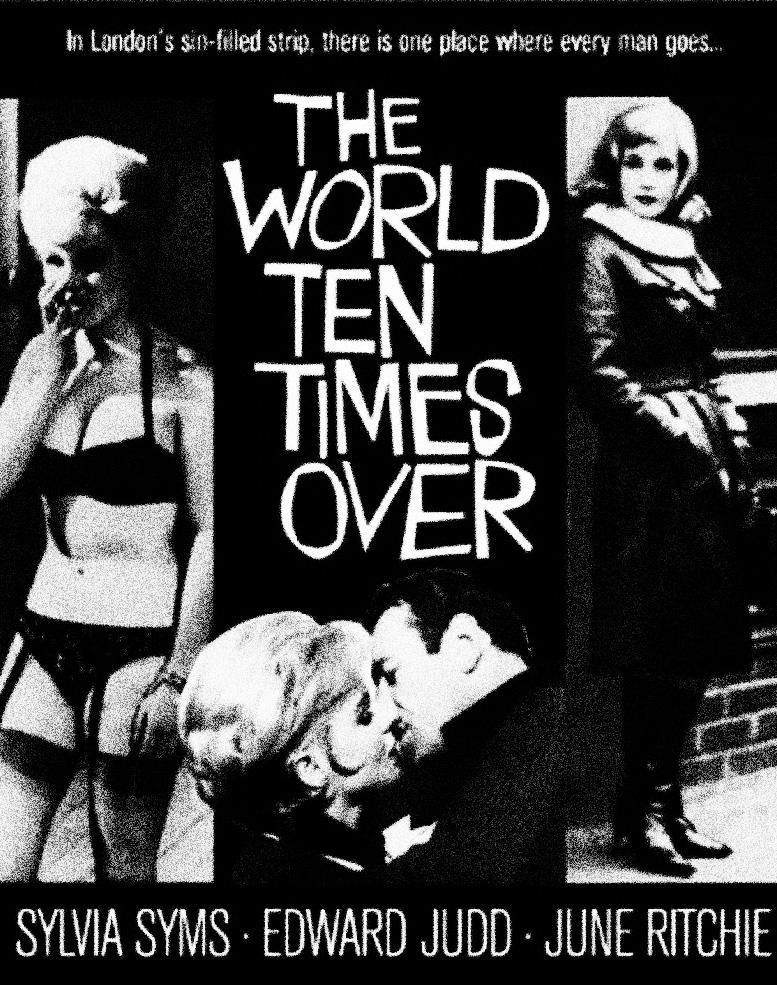
The World Ten Times Over-1963-film poster-Sylvia Syms-June Ritchie-Wolf Rilla-Soho-London-British film-Afterhours Sleaze and DignityWhen I recently rewatched the film I’m not sure that enjoyment is a phrase that I would use about it. I’m not knocking the film at all though, it’s more that it feels like a curiousity, a snapshot of a particular way of life and a transitional point in life and culture – post-war auserity about to make way for the colour, spark and vitality of first Swinging London and pop-art mod(ernisms) and later the evolutions and looseness of psychedelia and what has come to be labelled hippie-dom.

Peruse and consider the excitement of a belated and long awaited DVD release of the film at the fine Brit Movie and a good point of reference / review at The Digital Fix.


Posted on — Leave a comment

44 Inch Chest, further weathered suaveness and lives lived…

44 Inch Chest film poster-Ray Winstone-Ian McShane-John Hurt-Tom Wilkinson-Stephen Dillane-Joanne Whalley
Well, while we’re talking about weathered suaveness (see here)…

If you should want to gather up a few of such people from this side of the sea, well, 44 Inch Chest does a fair job of such things.

For a while I was somewhat obsessed by the poster for the film (and indeed it was a particular influence on a particular piece of my own Afterhours work).

44 Inch Chest film still-Ray Winstone

Although the layout of making sure all the prime members of a cast are present and displayed in a backward sloping arrow shape has become something of a commonplace occurrence these days (at the behest of publicity clauses in contracts or as a form of lending recognisable faces to a story or brand maybe?), this is something of a favourite of such things.

Why? Well, it’s that sense of weathered suaveness and more than a touch of menace. Not in the fizzy, hormone packed way that a youthful gathering may present, more in a sense of lives travelled and “now, let’s not have any messing about, son” manner.

Also, sometimes it seems as though some actors carry the possible routes their characters’ lives might take and their stories from one film to another.

44 Inch Chest film still-Ian McShane-Joanne Whalley
Take Ian McShane here. When I saw the poster, it felt as though I was looking at who Wolfe from Villain had become a fair few years later (via various misdemeanours and bother in Sitting Target, Freelance and higher up the layer cake during Sexy Beast along the way).

John Hurt – well, he may be playing a more working class chap here and he may be (I think) actually a “posher” gent in real life but if you should want to see the result of life lived on a face and (really rather) weathered suaveness then look no further.

44 Inch Chest film still-Joanne Whalley
And Ms Whalley? Well, this role may well be more no-nonsense moll-ish than the Christine Keeler in Scandal became or might have become, in either the film or actual life but there’s a link there via smoke filled bars or basements and too many years watching and hearing the promises from all around them.


Posted on — Leave a comment

16 Horsepower, transcendence and weathered suaveness…

David Eugene Edwards-Woven Hand-16 Horsepower-sixteen horsepower-2Somewhere along the line a certain kind of (sometimes Deep South) American gothic culture has been something I’ve visited, been intrigued by and indeed has influenced my own Afterhours work.

I couldn’t quite say how. A certain kind of texturalness? A sense of layered, hidden stories that thread deeply throughout places and people? A weathered suaveness? A stepping (figuratively) into the basements of the soul? It’s those and all kinds of other aspects I expect.

David Eugene Edwards-Woven Hand-16 Horsepower-sixteen horsepower-5-invertedIf I was to travel in that general direction, I expect 16 Horsepower would be an early and repeated port of call.

And if you should want the very essence of such things in an explorative and also traditional manner, well, they could well be a place to look.

(And it’s not much more than a brief move to other surrounding lands, travellers and those who have come afterwards: David Eugene Edward’s work with Woven Hand, the dusted plains heartbreak of Lillium and the like.)

I think the words reverent or transcendental would not be amiss here, something that can even be quite overt in their work – Mr Edward’s can indeed look like he is summoning or has travelled to another place during performance, something that brings to mind his own background and history in American preaching.

16 Horsepower-Live DVD-Glitterhouse-David Eugene Edwards-LilliumAlong which lines, I would particularly recommend the Live DVD they put out – beautifully packaged and referrring back to souls and basements, it features the last song they ever performed as 16 Horsepower – a cover of Joy Division’s Heart and Soul.

Now, a cover of a song by a band with such, well, heavy history is a tricky thing but this wanders to somewhere else.

Transcendence indeed.

David Eugene Edwards-Woven Hand-16 Horsepower-Bluebird Theatre-sixteen horsepower
As a PS and bringing such things/connecting them back to more traditional Afterhours territory, when I went a-wandering, I was glad to come across the image above of their name up in lights. In a fairer world etc etc this would have been a more justly common sight.

Visit the DVD at Glitterhouse here and a glance backwards here.


Posted on — Leave a comment

She Wears Red Feathers and a Hula Hula Skirt*

Scandal-1989 film-Joanne Whalley-Profumo Affair-Murrays-Christine Keeler
Well, where to start writing about Scandal, the 1989 film about the Christine Keeler/Profumo affair…

I’m somewhat wary about such things – lives were changed, ruined, lost as a result of the goings on during, after and around it. I’m drawn to the intermingled intrigue, the stories and the heady glamour of parts of the story but I’m wary of being, well, a rubbernecker or overly voyeuristic.

So, with that said. Scandal.

Scandal-1989 film-Joanne Whalley-Profumo Affair-Murrays-Christine Keeler-2This is a film I’ve lived with for a long time, probably since the late 1980s/very early 1990s when I first saw it but when I re-watch it, which is only relatively occasionally, it often leaves me reeling and well, genuinely moved.

Referring back to what I mentioned at the start of this post, initially it begins as what seem like high japes, all late 1950s/early 1960s glamour, style, indiscretions and hearts of London nightlife.

Something which is undoubtedly helped by, well, Ms Joanne Whalley (then a once Batman’s beau Mrs Joanne Whalley-Kilmer) looking rather lovely indeed, all slink and period eyeliner and captures the playfulness, beauty, sadness and later hunted fear of Ms Keeler rather well.

(As an aside, at that point she has taken a journey from brief popstar-ness, the north of England, prime-time 1960s-esque kitchen sink drama (A Kind Of Loving) to Mr George Lucas’ stories and Hollywood (Willow) back through the time-tunnel to the Profumo Affair via Peter Greenaway, very fine contemporary English conspiracy-noir (Edge Of Darkness), Alan Bleasdale (No Surrender), tragic tales of loves (Dance With A Stranger), Peter Greenaway and the like and then all the way back through the time tunnels to the Profumo Affair.)

Scandal-1989 film-Joanne Whalley-Profumo Affair-Murrays-Christine Keeler-John Hurt-Mandy Rice Davies
…but then, well, the reality and “If you live like this, this may well happen” kicks in and by the end what is striking and as I said, what leaves me reeling is the story of Stephen Ward, his hounding when the fun comes to an end and his untimely, sad death.

It’s the scene when he (played finely by John Hurt) is in court, in a framed, scapegoated, somebody has to take the fall for all this way, Christine Keeler is giving evidence, her evidence is being turned against him and his fate is being stitched up by the prosecution and he just stands up and shouts “This is not fair” and then repeats it again quietly, heartbreakingly that really gets me.

That and the human, day-to-day mention about his car needing oil in the note he leaves to his friend as he decides to “not let them get me”. Phew. It’s hard to even write about.

I just looked up the definition of tragic and one of them is “Very bad or inadequate”. That seems to sum up the behaviour and activities of the hounders at that time rather well.


*And the title of this post? Well, that’s one of the songs from the film’s nightclub scenes/its soundtrack.

Posted on — Leave a comment

Our Friends In The North – Imaginative Time Travel and Experiments In Consensual Hallucination

Our Friends In The North-1996-TV series-Peter Flannery-Afterhours Sleaze and Dignity

My interest in culture that draws from and reimagines an indefinable past stretches back a fair few years now. In the years back when the nightlife subculture I explored was a small, dedicated niche that consisted of but a handful of people.

It predated the current, ongoing, now over ten years old interest in / fashion for all things vintage and existed / exists alongside but apart from the likes of say more traditional, orthodox rockabilly/1950s and similar past era recreations.

Our Friends In The North-1996-TV series-Peter Flannery-Daniel Craig-Afterhours Sleaze and Dignity

At that time I would treasure and hanker after visions of speakeasy-esque nightlife / cabaret from times gone by which were created and represented in films such as Dance With A Stranger or say a television series such as Our Friends In The North.

Then with the vintage “boom”, such places became a reality, filled with a hundred and one burlesque stages but it wasn’t really for me. I’m not dismissive of such things, it’s just that I think the world, scenes and settings that I thought of were more a cerebral, imaginative creation than something that needed to be present in reality.

Our Friends In The North-1996-TV series-Peter Flannery-Afterhours Sleaze and Dignity-3

Rather than requiring a high-definition reproduction or facsimile of times gone by, to borrow from author Rob Young, this was more a form of “imaginative time travel” or “an experiment in consensual hallucination“.

Although Rob Young used these phrases to describe aesthetically different cultures/subcultures than the one from which Afterhours Sleaze and Dignity draws, the concepts themselves are still particularly apposite in this case – and indeed have come to be particular touchstones for my Afterhours (and other) work.

Visit Rob Young here. Visit Our Friends In The North here and peruse it here.

Posted on — Leave a comment

Biography Of A Buick and researchative entertainment

Bill Morris-Biography Of A Buick-1954 history-Marilyn Monroe-Elvis-front coverThere is a particular subsection of fiction that visits / weaves the lives and stories of relatively recent historical / cultural figures amongst its own tales.

Along Afterhours-esque lines, I would probably look towards Jake Arnott’s The Long Firm and its gathering of characters factual and fictional in 1960s Soho and Peter Doyle’s Get Rich Quick which tours with Little Richard and other early rock’n’roll-ers around Australia.

Recently I stumbled upon another fine slice of such things: Bill Morris’ Biography Of A Buick.

This is set in 1954 and based around the American car manufacturer General Motors and its staff.

This was a point in America’s history where things were on the up – inflation is low, employment is high, to a degree ownership of consumer items such as televisions and automobiles were becoming more widespread and the populuxe aesthetic is coming into being.

One of the things that particularly intrigued me while reading the book was the number of cultural events that happened / began to happen at that time which have become archetypal or steadfast parts of the modern-day landscape and psyche:

Bill Morris-Biography Of A Buick-1954 history-Marilyn Monroe-ElvisJoe DiMaggio marries Marilyn Monroe and watches as she films her famous white dress heat vent scene, Neal Cassidy and Jack Kerouac were making the car journeys across America that would lead to the epitomic beat novel On The Road, Elvis made his first radio appearance, the template for assembly line, franchised fast food was put in place.

It can be a tricky thing to use real people’s lives in amongst fiction in such a way but Bill Morris carries this out in a respectful, informative manner.

When done well and informed by a particular level of interest, passion and research, such books seem to be a particularly good way of learning about pieces of semi-hidden history, of connecting the dots and lines between particular historical events and cultural figures / work / settings; a form of researchative entertainment.

Fine work Mr Morris.

Peruse Biography Of A Buick (also known as Motor City) here.


Posted on — Leave a comment

Dead Men Don’t Wear Plaid and cultural splicing/time travelling…

Dead Men Dont Wear Plaid-Steve Martin-Rachel Ward-Carl Reiner-1982-film noir-Afterhours Sleaze and Dignity-4
Well, I guess lightening the tone a little after a consideration or two of the noir-ish time travelling of James Ellroy a touch more imaginative/cultural time travelling…

Dead Men Don’t Wear Plaid.

Dead Men Dont Wear Plaid-Steve Martin-Rachel Ward-Carl Reiner-1982-film noir-Afterhours Sleaze and Dignity-2This is a 1982 film starring a kind of dashing Steve Martin, a rather appealing Rachel Ward… oh and amongst others Barbara Standwyck, Ava Gardner, Burt Lancaster, Humphrey Bogart, Cary Grant, Ingrid Bergman, Veronica Lake, Lana Turner, James Cagney and a slightly jarring and unsettling for some reason Vincent Price…

Not a bad cast list…

Dead Men Dont Wear Plaid-Steve Martin-Rachel Ward-Carl Reiner-1982-film noir-Afterhours Sleaze and DignityIt was made in the days pre computer jiggery pokery and splices contemporary action with archival footage from 1940s films into something that is both an homage and loving spoof of 1940s film noir, period pulp detective fiction, their iconography, style, lighting, tales, tropes and language; all femme fatales who are also dames who need his help and night driving gumshoe-ery.

Dead Men Dont Wear Plaid-Steve Martin-Rachel Ward-Carl Reiner-1982-film noir-Afterhours Sleaze and Dignity-3Along the way the film wanders amongst and walks alongside amongst other films This Gun For Hire, Double Indemnity, The Killers, The Big Sleep, Dark Passage, White Heat, The Postman Always Rings Twice… with Phillip Marlowe handing out advice in the form of the aforementioned Mr Bogart (oh and touch or two of needlepoint – this is a comedy after all).

I suppose in a way the film could be to use a form of sampling – a technique that we have come to be used to in say music but that in mainstream cinematic and broadcast storytelling we don’t expect to see… and I suppose sampling is also a form of (cultural) time travelling…

Further information on precisely which pieces of cinematic history are spliced in the film can be found here. Peruse the film here.

Posted on — Leave a comment

James Ellroy and imaginative time travelling

James Ellroy-American Tabloid-LA Confidential-noir-imaginative time travel-Afterhours Sleaze and DignityIn a recent(ish) interview with author James Ellroy he described himself as a time traveller, that his telling and unearthing of the stories of times gone by (largely the 1940s and 1950s) is a form of time travel and also described himself as a romantic when it was put to him that his work was a romanticised take on those eras.

These were ideas that connected with ones that I’ve had wandering around for a while now and links with writer Rob Young’s sense of “imaginative time travel” within cultural work and activity and also his description of certain night life events being “experiments in consensual hallucination”.

I suppose an intermingling of those interconnected ideas could well be some of the main themes of Afterhours Sleaze and Dignity and my own work; the creation of imagined worlds, where the iconography, styles and tales of former periods are recreated in an almost archetypal manner.

They are distilled into their essence and their spirit recreated, although not in a pixel-perfect recreation of times gone by, rather a reimagining, a sideways glance at an indefinable past alongside a willing suspension of disbelief and overlooking or even incorporating of incongruous details.

James Ellroy-American Tabloid-LA Confidential-noir-imaginative time travel-Afterhours Sleaze and Dignity-3 James Ellroy-American Tabloid-LA Confidential-noir-imaginative time travel-Afterhours Sleaze and Dignity-4

James Ellroy-American Tabloid-LA Confidential-noir-imaginative time travel-Afterhours Sleaze and Dignity-2Some of the uses of the word quixotic might well have a place here or to return back to that word, romantic or sepia-tinged (without the associated sense of sometimes cloying sweetness – which I don’t think is really a take on romantic which could easily be applied to the work of James Ellroy).

(As an aside, when I think of such ideas, I seem to often wander back to the 1980 Christopher Reeves film Somewhere In Time, wherein a playwright uses self-hypnosis to travel back in time to a more suave earlier twentieth century era to meet a woman with whose photograph he has become smitten)…

Visit discussions with James Ellroy on time travel here.

Peruse James Ellroy’s resulting work here.


Posted on — Leave a comment

A Vision Of Loveliness, pre-Swinging London glamour and tales of West End popsies

A Vision of Loveliness-Louise Levene-Afterhours Sleaze and DignityA curious book Louise Levene’s A Vision Of Loveliness.

It begins like a humourous, if at times grim and snobbery bound, snapshot of a previous era in Britain’s history (the late 1950s/early 1960s to be precise) that is all kitchen sink-esque non-glamour and pre consumer choice/disposable incomes; condemned gas geysers, every meal tipped out of a can, twitching curtains and conformity, dead-end jobs and maybe one good suit or outfit to wear if you’re lucky.

It is a tale that is played out in a time before the true explosion of teenage tastes, styles and money to throw at fashion and fripperies; a time when glamour and style even of the young was nearer to hidebound tailoring, evening gowns and set hairdos.

The story is framed through the lens of a young gal (not yet twenty) who is desparate to improve herself, the circles she moves in and indeed her wardrobe.

Be careful what you wish for though.

A Vision of Loveliness-Louise Levene-Picadilly Circus-West End-London-Afterhours Sleaze and Dignity

Beauty and the body are a commodity to be traded for a nice pair of shoes or a plushly carpeted flat in Mayfair; the West End popsies who are these particular visions of loveliness look to the “favours” of moneyed older generations in order to acquire the fashions they desire…

A Vision of Loveliness-Louise Levene-Soho-West End-London-Afterhours Sleaze and Dignity

…as time passes – and suprisingly little time or indeed few action/decisions, the steps from A to there can be but one or two – and the pages turn, the book takes a considerably darker, more cynical turn and comes to remind me of the scandal, sleaze and exchanges that may well have taken place around/around the edges of the Profumo Affair in the heart of London back then and when.

Read the (slightly misleading/possibly more morally hopeful than the tale itself) background information/blurb from the book here.

Peruse the book here.


Posted on — Leave a comment

Otto Penzler, noir distinctions and knights in tarnished armour

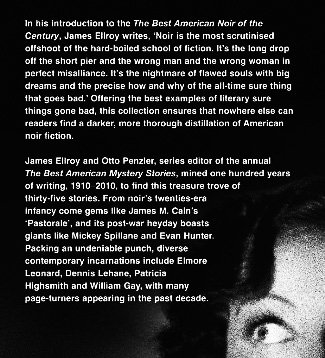
The Best American Noir Of The Century-James Ellroy-Otto Penzler-James M Cain-Mickey Spillaine-Evan Hunter-Elmore Leonard-Dennis Lehane-Patricia Highsmith-William Gay-Afterhours Sleaze and Dignity-2I was recently reading Otto Prenzler’s foreword to The Best American Noir of the Century compendium that he co-edited with James Ellroy.

In it he puts forward the idea that the mystery genre/private detective stories and noir fiction “are diametrically opposed, with mutually exclusive philosophical premises“.

I’ll reproduce an (edited) version of his arguement/distinctions here:

“Noir works, whether films, novels or short stories, are existential, pessimistic tales about people, including (or especially) protagonists who are seriously flawed and morally questionable. The tone is generally bleak and nihilistic, with characters who greed, lust, jealousy and alienation lead them into a downward spiral as their plans and schemes inevitably go awry… the likelihood of a happy ending in a noir story is remote… It will end badly, because the characters are inherently corrupt and that is the fate that inevitably awaits them.

“The private detective story is a different matter entirely. Raymond Chandler famously likened the private eye to a knight, a man who could walk mean streets but not himself be mean… They may well be brought into an exceedingly dark situation and encounter characters who are deceptive, violent, paranoid and lacking a moral center, but the American private detective retains his sense of honour in the face of all the adversity and duplicity with which he must do battle.”

The Best American Noir Of The Century-James Ellroy-Otto Penzler-James M Cain-Mickey Spillaine-Evan Hunter-Elmore Leonard-Dennis Lehane-Patricia Highsmith-William Gay-Afterhours Sleaze and DignityFood for thought, as noir tends to be thought of as more an aesthetic than philosophical / existential concern. All moody 1940s detective film lighting, hats tipped over eyes in night time side alley and the like.

And all of which got me thinking and considering somewhat; although I expect it would not be hard to place many of the stories and characters of say James Ellroy’s own work reasonably firmly in the noir camp, where walks Oswald Mosley’s fictional often non-professional crime investigator Easy Rawlins?

Yes, he is a crusading knight in some ways but in the series of books there is a sense that the resolving of a situation or case may provide only temporary respite; that he is a man just about managing to tread water amongst the darkness / moral questionability that he walks amongst but which is also quite possibly within him and for which he is sometimes culpable for by his actions, non-actions or sometimes mere presence and intrusion.

I suppose essentially, it’s a case of such things not quite being black(noir) or white. A bit more and/or/both.

Read more on Otto Penzler, The Mysterious Bookshop and a life amongst such tales here.

Ezekiel “Easy” Rawlins here.

Peruse The Best American Noir of the Century here.